





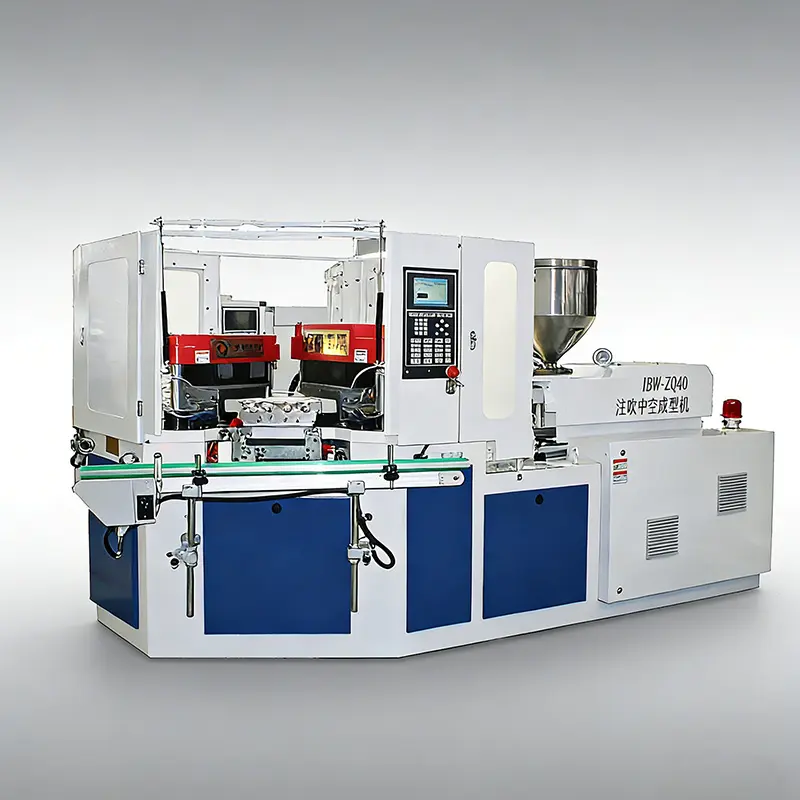
For an importer, distributor, or factory buyer, choosing the wrong type is a costly mistake. A machine built for HDPE detergent bottles cannot make clear PET water bottles. A machine built for small eye-drop bottles cannot make large industrial drums.
This guide explains how each type works, what it produces, how the three compare, and what affects price. Zhangjiagang Ziqiang Machinery Co., Ltd. (ZIQIANG) wrote it from more than 20 years of blow molding equipment experience. We supply customers in more than 30 countries and regions.
What Is a Blow Molding Machine?
A blow molding machine turns melted plastic into hollow products. The process has four basic steps:• Melt the plastic resin and shape it into a hollow tube or a preform.
• Close a mold around that shape.
• Blow compressed air inside to press the plastic against the mold walls.
• Cool the part, open the mold, and eject the finished product.
The three types differ mainly in how they make the hollow tube or preform. Extrusion machines push melted plastic through a die head. Injection machines mold the preform first in an injection unit. This one difference affects neck accuracy, material waste, container shape, and the resins you can use.
Types of Blow Molding Machine at a Glance (Quick Summary)
.webp)
Here is the short answer to “what are the types of blow molding machine?”
• Extrusion blow molding (EBM): extrudes a hollow tube called a parison. Best for HDPE and PP bottles, jerry cans, drums, and tanks.
• Injection blow molding (IBM): injects a preform onto a core rod, then blows it. Best for small, precise bottles in pharmaceutical, cosmetic, and food packaging.
• Injection stretch blow molding (ISBM): injects a preform, stretches it, then blows it. Best for clear, strong PET bottles and jars.
Extrusion Blow Molding (EBM) Machine: How It Works
An extrusion blow molding machine is the most widely used type. Buyers also call it a blow molding extrusion machine, an extrusion blow molder, or a blow molding extruder. It is the usual choice for large containers and for high-volume bottle production in HDPE and PP.The four-step process
• Extrusion: the extruder melts plastic pellets. The extrusion head forms a soft hollow tube called the parison.• Clamping: the mold closes around the parison and pinches the bottom.
• Blowing: compressed air inflates the parison against the mold walls.
• Cooling and ejection: the part cools, the mold opens, and the part is ejected. Excess plastic (flash) is trimmed off.
Good extrusion blow molding equipment controls parison wall thickness. Programmable control puts more plastic where the part needs strength. This lowers material use and keeps part weight consistent.
Single station and double station models
ZIQIANG's Extrusion Blow Moulding Machine range includes a Fully Automatic Extrusion Blow Molding Machine (Single Station) and a Fully Automatic Extrusion Blow Molding Machine (Double Station). Single station models include the ZQY60, ZQY75, ZQY80, and ZQY90. The double station line includes the ZQY60D.A single station machine runs one mold per cycle. It fits small and medium volumes, limited floor space, and frequent bottle changes. A double station machine runs two independent mold stations and raises output. Buyers with stable, higher-volume orders often look at the Fully Automatic EBM (double station) series first.
Injection Blow Molding (IBM) Machine: How It Works
An injection blow molding machine combines injection molding and blowing in one machine. It suits small bottles that need accurate necks and clean finishes.• Injection: melted plastic is injected around a core rod to form a preform with the final neck and thread.
• Transfer: the core rod moves the preform to the blowing station.
• Blowing: air expands the preform inside the bottle mold.
• Ejection: the finished bottle is released.
Because the neck is injection molded, threads are precise and the bottle needs no flash trimming. This matters for medicine bottles, eye-drop bottles, cosmetic containers, and small food bottles. Buyers usually choose IBM for small to medium containers, not large drums.
ZIQIANG's core line is the Injection Blow Molding Machine, with models such as the ZQ40, ZQ60, ZQ80, ZQ110, and ZQ135. Drive options include all-electric, servo, and hydraulic systems.
Injection Stretch Blow Molding (ISBM) Machine: How It Works
An injection stretch blow molding machine adds a stretching step. A stretch rod pulls the preform lengthwise while air blows it outward. This two-way stretch orients the plastic, which makes PET bottles clear, light, and strong.• One-step ISBM: preform injection, conditioning, and blowing happen in one machine. Handling is minimal, and the process is flexible for different shapes and smaller runs.
• Two-step ISBM: preforms are molded first, then reheated and blown on a separate stage. This suits high-volume production such as water and beverage bottles.
• Semi-automatic: an operator moves preforms between stations. This lowers investment and suits start-ups and trial production.
ZIQIANG's Injection Stretch Blow Moulding Machine range covers semi-automatic, one-step, and two-step models. Our bottle series include water, beverage, chemical, daily chemical, food jar, and oil bottles.
Pros and Cons of Each Type of Blow Molding Machine
Extrusion blow molding (EBM)
• Pros: makes large parts and complex shapes, including handle containers. Runs HDPE, PP, and PVC. Molds generally cost less than injection-based molds. Suits high-volume output.• Cons: neck accuracy is lower than IBM. Flash must be trimmed and reground. Wall thickness can vary on complex shapes without good parison control.
Injection blow molding (IBM)
• Pros: precise neck and thread. No flash. Consistent bottle weight and a clean finish.• Cons: limited size and shape range. Mold cost per set is higher. Not suited to large drums or handle containers.
Injection stretch blow molding (ISBM)
• Pros: clear, strong, lightweight PET bottles. Good for carbonated drinks and water. High output on two-step lines.• Cons: mainly for PET and similar resins. Needs both preform molds and blow molds. Investment is usually higher for full lines.
Blow Molding Machine Types Compared: Table
Use this table to shortlist the right type. Confirm final details with your supplier before you order.| Feature | EBM | IBM | ISBM |
| Preform method | Extruded parison | Injected preform on a core rod | Injected preform, then stretched |
| Typical materials | HDPE, PP, PVC | PE, PP, PS and other common resins | PET and similar resins |
| Container size | Small to very large | Small to medium | Small to large-volume bottles |
| Neck and thread accuracy | Good; neck area is trimmed | Very high | High |
| Material waste | Flash trimmed and reground | Almost none | Low |
| Typical products | Detergent bottles, jerry cans, drums, tanks | Medicine, eye-drop, and cosmetic bottles | Water, beverage, oil bottles, food jars |
| Best for buyers who need | Large or handle containers in HDPE/PP | Precise small bottles | Clear, strong PET bottles |
Which Products Does Each Blow Molding Machine Make?
• EBM products: household chemical and detergent bottles, personal care bottles, jerry cans, drums, tanks, and automotive fluid reservoirs. These extrusion blow molding products cover many industrial and consumer uses.• IBM products: pharmaceutical bottles, eye-drop bottles, cosmetic and personal care bottles, and small food bottles.
• ISBM products: water, juice, beverage, edible oil, and chemical bottles, plus wide-mouth food jars.
Best Blow Molding Machine for PET Bottles
For PET bottles, choose an ISBM machine. PET needs stretching to reach its clarity and strength. Standard extrusion machines are built for HDPE and PP, so they are not the usual route for clear PET water or beverage bottles.Then decide which ISBM format fits your plan:
• Two-step for high, steady volume, such as water and beverage bottles.
• One-step for small to medium volume, varied bottle shapes, and less preform handling.
• Semi-automatic for start-ups, trial runs, and tight budgets.
Best Blow Molding Machine for HDPE Containers, Drums & Tanks
For HDPE containers, drums, and tanks, choose an EBM machine. HDPE is strong, resists chemicals, and costs less than many other resins. It is the standard material for detergent bottles, lubricant bottles, agrochemical containers, jerry cans, and drums. A fully automatic extrusion blow molding machine runs the whole cycle without manual handling, which lowers labor cost and keeps output consistent.If you are starting small, a small extrusion blow molding machine in a single station layout can be a practical first step.
Some products need a barrier against oxygen, moisture, or chemicals. In that case, ask about a multilayer extrusion blow molding machine. For very high output, ask about a rotary extrusion blow molding machine. Confirm with your supplier which configurations they can build for your resin and bottle design.
For any plastic extrusion blow molding project, send your bottle drawing, part weight, resin type, and target output. With these four items, an engineer can recommend the right screw, die head, and clamping size.
Other Types of Blow Molding Machines (Multilayer, All-Electric, Hydraulic)
.webp)
Beyond the three main processes, machines are also grouped by structure and drive system:
• Multilayer machines co-extrude several plastic layers into one wall. They add barrier, UV protection, or recycled content between layers.
• Hydraulic machines offer strong clamping force and proven reliability. They are common on larger EBM machines.
• Servo machines use servo motors to cut energy use compared with standard hydraulic drives.
• All-electric machines give clean operation, precise motion, and low energy use. The upfront price is usually higher.
Blow Molding Machine Price by Type
Extrusion blow molding machine price, like the price of any blow molding machine, depends more on size and configuration than on type alone. We do not publish fixed prices because a fair quote needs your product details. These factors drive cost:• Machine size, clamping force, and shot size.
• Single or double station, and the number of cavities.
• Control system level and automation features.
• Drive system: hydraulic, servo, or all-electric.
• Mold cost, which suppliers usually quote separately.
• Auxiliary equipment such as loaders, grinders, conveyors, and deflashing units.
• Shipping terms, installation support, and spare parts.
When you search for an extrusion blow molding machine for sale, compare full quotations, not headline prices. Ask for machine, mold, spare parts, and shipping terms (FOB, CIF) listed separately. A direct quotation from an extrusion blow molding machine China factory makes this comparison easier.
How to Choose the Right Type of Blow Molding Machine
• Start with the product. Note the bottle shape, size, weight, and neck finish. A drawing or sample helps.• Match the material. HDPE and PP point to EBM. PET points to ISBM. Small, precise bottles in PE, PP, or PS point to IBM.
• Set your output target. Decide bottles per hour, then choose the station and cavity setup.
• Choose the automation level. Fully automatic suits continuous supply. Semi-automatic suits trials.
• Plan the mold. Confirm cavity number, changeover time, and who makes the mold.
• Check utilities and space. Confirm power, compressed air, cooling water, and floor area.
Supplier selection tips
• Ask for videos of machines running products similar to yours.• Request an itemized quotation with clear delivery terms.
• Confirm the documents your market needs, such as CE marking or material certificates, before you order.
• Ask about installation guidance, operator training, and spare parts support.
Why Buy Blow Molding Machines from Ziqiang Machinery?
Zhangjiagang Ziqiang Machinery Co., Ltd. is based in Zhangjiagang, Jiangsu, China. Our team builds all three main types under one roof, so you can compare options with a single supplier.• Experience: more than 20 years in blow molding equipment, with a team of 50+ employees.
• Full range: IBM, EBM, and ISBM machines, plus auxiliary machines and molds.
• Customization: OEM/ODM support for machines and molds, matched to your bottle size, cavity number, and process.
• Control: PLC touch-screen systems designed for easy operator training.
• Export reach: customers in more than 30 countries and regions, including importers, distributors, and OEM/ODM buyers.
• Industry presence: we exhibited at CHINAPLAS 2026 in Shanghai (April 21–24, 2026).
We share only documents we can verify. If your project needs specific certificates or test records, ask us which ones apply to your model.
FAQs About Types of Blow Molding Machines
What are the three main types of blow molding machine?The three main types are extrusion blow molding (EBM), injection blow molding (IBM), and injection stretch blow molding (ISBM). EBM suits large HDPE and PP containers. IBM suits small, precise bottles. ISBM suits clear PET bottles.
Which type of blow molding machine suits PET bottles?
An ISBM machine suits PET bottles. The stretching step gives PET its clarity and strength. Two-step machines fit high-volume water and beverage lines, and one-step machines fit smaller, more varied runs.
What is the difference between single station and double station EBM machines?
A single station machine runs one mold per cycle and suits smaller volumes or limited space. A double station machine runs two independent mold stations, which raises output for stable, higher-volume production.
What affects the price of a blow molding machine?
Machine size, station layout, cavity number, control level, drive system, mold cost, auxiliary equipment, and shipping terms all affect price. Ask for an itemized quotation so you can compare suppliers fairly.
What information should I send to get a quotation?
Send your bottle drawing or sample, resin type, part weight, target output, local voltage, and destination port. This lets the engineering team recommend a suitable model and mold setup.
Conclusion
The right types of blow molding machine depend on your product, material, and volume. Choose EBM for HDPE and PP containers, drums, and tanks. Choose IBM for small bottles with precise necks. Choose ISBM for clear, strong PET bottles. Then compare suppliers on full quotations, support, and documentation, not on price alone.If you are comparing an extrusion blow molding machine or another type for your next project, contact us with your bottle drawing, resin type, and target output. Our team can share product details, a quotation, customization options, and technical support for your market.